
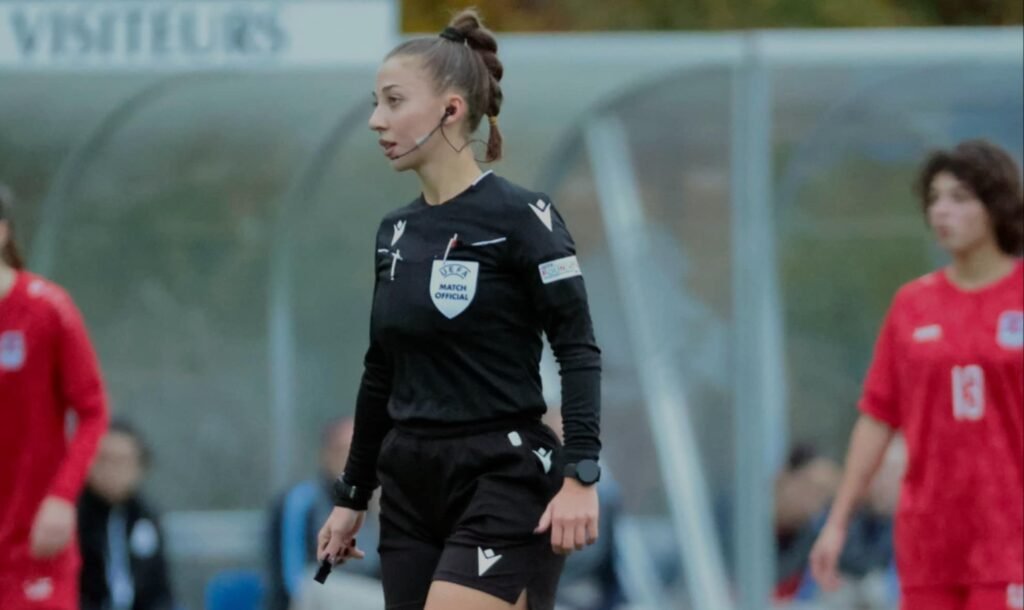
Mzeko Sharashenidze: “After successfully refereeing a women’s football match, there is talk of entrusting us with refereeing men’s football at the international level as well. My next goal and my motivation are precisely this”…
Last week, in the Lazio region, we Italian referees went on strike. The frequent abuse directed at referees, physical assaults and the turning of the workplace into a stressful environment recently led the Italian Referees’ Association to make a radical decision. No football as long as the referee’s safety on the pitch is in question! – This was the main idea that united all of us.
Football is a universal sport. Regardless of gender, skin color or religion, everyone watches it. Often nobody cares about the fact that football has 17 laws. These same laws also come with additional explanations, and during the match it is precisely the referees who are responsible for upholding all of this.
Preparing for a specific match requires not only knowledge of the rules, but also passing fitness tests. A referee is just as much an athlete as any footballer. With the difference that he or she is responsible for controlling compliance with the rules during the game.
Coaches, club presidents, footballers and even football agents easily win the sympathy of the public, which cannot be said of referees. The only one whom everyone in the world still deeply respects to this day is the Italian Pierluigi Collina. Everyone has the same opinion about his professionalism and authority…
“Make a wide road for women”…
…was the title of the interview that, in 2008, while still working at “Sarbieli”, I dedicated to encouraging women referees in Georgian football. Back then I could not even have imagined that one day I myself would take the whistle in my hand and referee a football match. In my life as a sports journalist, my membership in the Italian Referees’ Association came about entirely by chance.
The constant arguing and dialogue with referees of the former “Roma” coach, José Mourinho, was the reason I became interested in this topic. At first, I wanted to learn the updated version of the rules of the game from the professionals themselves. With this aim, I enrolled in a refereeing course. After the course ended, again out of interest, I took the exam. Then came a three-day gathering in the Abruzzo region, passing the fitness tests and soon afterwards refereeing my first Under-14 match.
That I would one day become a referee was certainly not something I had planned. I got carried away by a challenge, which showed me football from yet another angle. It is one thing to follow the course of a match from the press box, and another when you are the referee yourself and decide the fate of the game on your own.
Fate also played its part. Among the sections that exist in Rome, I chose “Roma 2” without even thinking about it. It turned out that this section is named after Riccardo Lattanzi – that very Lattanzi who, on 13 May 1981, in Düsseldorf, refereed the final that brought the historic victory to Tbilisi’s “Dinamo”, and ended his international refereeing career with precisely that match.
Talking about this profession and sharing ideas with others had been going around in my mind for a long time. Since I am a member of the Italian Referees’ Association, I wanted to make a comparison with the Georgian reality.
I asked Mzeko Sharashenidze, a young, successful referee with a great future, to exchange ideas about this highly responsible profession, and she gladly agreed to my request.
An unpopular profession
“In 2018 I was in my second year at university when, completely by chance, I was offered refereeing – this is how Mzeko begins her story – We often gathered among friends and watched Champions League matches all together on a big screen…
At one such gathering I met a practising referee, who told me that a referees’ academy had opened in Georgia and advised me to take the course. At that moment I did not take it seriously. I had always wanted to be in the world of football, but I could not picture myself as a referee. And yet I had always been curious about how referees make decisions in a matter of seconds”. Soon the offer became real, and a few months after completing the refereeing course, Mzeko was also entrusted with her first match.
“I liked the refereeing process so much that I felt I could no longer endure without it – Mzeko shares her unconditional love for the job with happy emotion – when we have a break, I even long to get back onto the pitch soon”.
A rare phenomenon
Football is considered a men’s sport. And yet this sport has its rules, the observance of which is mandatory for everyone. I have already mentioned above that football is a popular sport. Fans believe that they know its rules well. When a referee takes a stand on a disputed decision, they are accused of not knowing those very rules. In such a case, if the referee is a woman, this stereotype becomes even stronger.
“Before I arrived, the Georgian refereeing team had been served by only two women in 20 years of experience – Mzeko shares her first steps – Before they entrusted me with my first match, I had to go a long way. Theoretical materials, studying the rules of the game, a period of physical preparation in order to pass the fitness tests…
I have always been sporty, I have played tennis since childhood. Additional work on myself enabled me to pass, with dignity, even the fitness tests designed for men. At the age of twenty, something appeared in my life that today is no longer merely a job, but a pleasure. Soon I also had a goal: to referee at the international level and to become a member of the UEFA referees’ team”.
Sports journalist or referee?
Mzeko’s emotions are similar to mine. It seems that for any referee the first match is equally emotional. I was no exception. On Wednesday morning I was informed by e-mail that on Saturday I would have to referee a match of the first round of the Under-14 boys’ competition. I felt I was not ready for such a big responsibility. If it had not been for Luigi Galiano, the head of our technical team, I would probably have refused.
“I have sent you the first match and you need to press the Accetto (I agree) button”, – Luigi wrote to me. Like other novice referees, I too showed hesitation. “The observer will be right there and will help you”, – he told me, and I boldly agreed to referee my first match.
The match between “Atletico 2000” and “San Cesareo” was scheduled for me at 18:00 in the evening. I made many naive mistakes, but when I blew the final whistle, I had a smile of pleasure on my face. As Mzeko said above, I too felt, and enjoyed, what an interesting process it is when you are the referee. “The first match I refereed, I remember the course of the game, but what I was doing and why, I cannot recall – this time it is Mzeko who shares her experience – Along with emotions, the first match also brings confusion, but the observer helps you and that encourages you. A few years ago, in Georgian football, a woman referee was a rarity.
Fans and footballers did not understand why I was on the pitch and told me where I should sit. When I explained that I was the referee, astonishment showed on their faces. Soon I moved to the amateur league, where adults play. When they see a woman, a certain attitude arises.
They are a little surprised, a little confused, but they try to meet novelty in a healthy way. In the beginning there was also the fact that they protested against playing incidents. They see a little girl and think that, since they themselves are men, they surely know more than you. There were often shouts too – “How can you referee?”.
“Today the picture is different, – and I see that, as she speaks, satisfaction is imprinted on Mzeko’s face – the same footballers were themselves witnesses of how I began and how, step by step, I became a professional in my field”.
Six years have passed since then. Today Mzeko is already a professional referee. In the national league she sits in the video referee room and is entrusted with judging the fate of the match using modern technology. In the second league of the Georgian championship Mzeko is a fourth official, and in the lower leagues she also takes on, with dignity, the role of main referee. Two years ago she also refereed in the national league. In that match Khatuna Maisuradze was appointed as the main referee, while Mzeko was appointed as the fourth official.
The referee as an authority
It is a completely different emotion when you watch the pitch and the playing incidents from the stands. You also have the possibility of checking a specific incident on a replay on your phone and, on that basis, concluding whether the referee whistled correctly or not. Today’s football is equipped with modern technology and referees have far greater resources to make fewer mistakes.
“For the first three years I was an assistant referee, – Mzeko continues her narration. Then I wished to take the main referee’s tests and changed position. The experience of being an assistant referee was very useful to me in spotting offside.
When you are the main referee, it is essential to choose your position correctly, in order to see the moment correctly and assess it accordingly. You must also be able to read the game. You must roughly sense, in that particular incident, what development might follow. No less important is game management. If the game “runs away” from you and you fail to establish correct communication with the teams, you also lose control of the game”. It is hard not to agree with Mzeko’s words. I also have personal experience of how the coach of one of the teams tried to protest a specific playing incident by expressing excessive emotions.
And yet I was officiating only my second match, and I had no experience in managing a similar incident. As soon as the playing incident was stopped, I punished the coach with a yellow card, so that he would restrain his emotions. This inflamed him even more. Soon I also noticed that the footballers were playing tensely, as if infected, and managing that match would become difficult if I did not send the coach off the pitch.
The observer assessed my decision positively. As he noted, at a critical moment I had shown character and had not lost control of the match. I mentioned character and, among the important details, there is also the fact that footballers should see in the referee, along with a professional, an authority.
DOGSO & SPA
Denying an obvious goal scoring opportunity (აშკარა საგოლე შესაძლებლობის მოსპობა) and Stop a promising attack (პერსპექტიული შეტევის შეჩერება) – acronyms of two different types of offence, the correct reading and assessment of which points to a referee’s professionalism.
“If playing incidents are not assessed correctly, football will not be as good as the fans expect, – Mzeko shares her view and I agree – the rules of football are prone to being forgotten. That is why I repeat Law 12 especially often. Experience and professionalism are shaped by the mistakes you have made and help you to grow.
What you got wrong once, you will not repeat. I recently refereed a match in which I used 5 red cards and 13 yellow cards. In this one particular match I awarded 3 penalties. It is clear from the statistics too that it was a difficult game”.
A three-second window
“The wise are those who think. A referee cannot be wise. He must be impulsive, because he has to make the decision within a window of three seconds”…
Pierluigi Collina
“I realized how difficult it turns out to be to blow the whistle, make a decision and then communicate that decision to the footballers within a 3-second window, – Mzeko assesses this difficulty as a challenge – making such a responsible decision in seconds, even I am surprised at how I can do it.
Often it is necessary to apply the unwritten, but well-known to referees, Law 18 as well. It implies an individual approach from the referee and the management of playing incidents. Refereeing teenagers is the hardest, because parents are especially emotional. One day a child’s mother was protesting a playing incident excessively, she wore me out so much that, as soon as the ball went out for a throw-in, I turned around and said to her – madam, the whistle is right here, come and referee yourself. Today such protest no longer affects me at all. A referee’s approach to a match changes radically when refereeing a match of professional footballers”.
An international-level referee
“When I found out that my candidacy had been sent to UEFA, I was very happy, – this time Mzeko shares the emotions brought on by the goals achieved – after passing the English language exam, I also successfully passed the exam on the laws of the game. In Georgia our fitness coach is Giorgi Antenidze, who made a great contribution to my physical development. It is thanks to him that I also successfully passed the fitness test at the international level”.
Mzeko’s expectation soon became a dream come true. It is also a joy that 2024 turned out to be a successful year for Georgian referees. The first historic matches in the European referees’ family, from both the women’s and the men’s side, give us hope that this is only the beginning.
“Georgian women referees had never officiated under the auspices of UEFA”, – Mzeko this time shares the joyful news with the air of a winner, – until now we had never had a woman main referee in UEFA. The first match to which I was appointed was a qualifying-stage match of the Women’s European Championship between Kazakhstan and Armenia.
On 4 June 2024 we wrote history, and the Georgian women referees’ team refereed an international-level match. The main referee was me, the assistants were Sopo Tsulaia and Elene Eloshvili, and the fourth official was Teona Sturua. After the successful debut, soon afterwards I was involved as fourth official in a Women’s Champions League match.
The main referee was Goga Kikacheishvili, while his assistants on the pitch were Davit Akhvlediani and Davit Gabisonia. It is a joy that Georgian men referees too have had many successes this year. For the first time in Georgian refereeing history, the Champions League match between Graz’s “Sturm” and Lisbon’s “Sporting” was refereed by Giorgi Kruashvili”.
The future belongs to women!
“I thought that outside the borders I would find it hard to find a common language of communication, but to my surprise it turned out to be much easier, – at the end of our conversation Mzeko also shared her plans for the future with me – European teams know that we referees represent international organizations and that in their eyes we are qualified professionals.
I believe that I have made a name for myself in Georgia too. After successfully refereeing a women’s football match, there is talk of entrusting us with refereeing men’s football at the international level as well. My next goal and my motivation are precisely this”.