
Two Footballs, One Reality
Georgian football is divided into two branches. On one side is the Georgian national championship, and on the other side the national team. These are two different roots, which have sprung up on the same territory, and on whose direction there is still no answer to this day.
Playing in the various categories of the Georgian national team, apart from patriotic motives, opens for the Georgian footballer a path to the eyes of scouts. And this is the chance that the footballer, on the way toward European football, will certainly try to use.
If playing for the national team has become a kind of selection, where is the place of the national championship? Here we come precisely to the main pain. The Georgian national championship stands apart, and its quality is so low that for a player from the local championship to make it into the national team’s starting line-up is a rarity. The main core of the national team is represented precisely by the legionnaires, the footballers who compete in various countries of Europe.
This is the reality of our Georgian football, which they read well in Belgium and which in the end also became our Achilles heel.
The Hard Road to the European Tournaments
For several decades Georgian clubs have been unable to reach the main stage of European tournaments. The last Georgian club that took part in the group stage of a European tournament was Dinamo Tbilisi, in the 2004/05 UEFA Cup. In Europe, Dinamo Tbilisi is regarded as the flagship of Georgian football. With its past it also creates for us a proud image, but Dinamo, like other Georgian clubs, cannot get past the qualifying stage of European club tournaments.
We have grown used to the fact that Georgian clubs find it hard to accomplish this task. We have grown used to the fact that the national championship stands far from internationally recognized standards. Faulty infrastructure, wages often delayed because of lack of money, disorganized youth football, a shortage of strong sponsors: we have grown used to the fact that this is our reality. And the result of this reality is yearly disappointment. The stands of the national championship are empty; Georgian football has supporters only at the level of the national team. As a result, Georgian club football for two decades now had not been able to pass the qualifying stage of European tournaments, until this vicious circle was ended by Iberia of Tbilisi.
In the 2026/27 season Iberia 1999 began their path in European club tournaments from the qualifying stage of the Champions League. After being knocked out of the Champions League, the team moved to the Europa League qualifying stage, but in the play-off they were defeated by Jagiellonia 1–6 on aggregate over the two matches and moved into the league phase of the Conference League.
We are talking about the reigning champion of the national league, a team that has celebrated the Georgian championship for the third time in its history.
The title of reigning champion of Georgia is a measure of superiority won inside the country, but it does not guarantee competitiveness at the European level. And it is precisely here that the main question of Georgian club football emerges: to what extent does the national championship create an environment that prepares a club not only for victory inside the country, but also for competing at the European level?
Sint-Truiden
I flew from Rome to Brussels at 9 a.m. I had planned the journey so that from the airport I headed by train directly to Sint-Truiden. For the first time in my professional career I had the opportunity to attend, with the status of a sports journalist, the participation of a Georgian club in a European tournament. The night before, the Champions League match, the emotional “Roma”–”Real” game, had charged me up, and I got ready to describe a historic day of Georgian football.
Iberia 1999 and Georgian club football were holding their historic first match precisely in Sint-Truiden.
From Brussels the train was on the spot in an hour. The match is scheduled for 9 p.m. I have plenty of time to get to know this historic Belgian city.
Sint-Truiden, a city located in the Flanders region, in the province of Limburg, has about 40 thousand inhabitants. The city’s history is linked to the Middle Ages and to the monastic settlement founded by Saint Trudo. Over the centuries Sint-Truiden was a religious, trading and agricultural centre; today it is especially well known for its fruit orchards and fruit production.
The city’s local football club, Sint-Truidense Voetbalvereniging, is part of its identity. The history of the club’s founding is also interesting.
STVV was created in 1924 through the merger of two local teams, F.C. Gold-Star and F.C. Union. The club’s history and its stadium are closely tied to the city. STVV have played their home matches at Stayen since the 1926–27 season.
The renewed version of the stadium itself seemed to me so original that I consider its concept an excellent find for the small stadiums of many Georgian cities.
Stayen is not a space intended only for football. Here the stadium, a shopping centre, a hotel, and office and conference spaces are united in one complex. The football pitch is the centre of this multifunctional environment, but not its only purpose.
At first glance, gathering so many different functions into one space could become a source of chaos, but Stayen’s concept is built precisely on their coexistence. What impressed me especially pleasantly is that here a person can come to shop, hold a business meeting, stay in the hotel and also attend a football match in the same space. The stadium is not a facility separated from the city’s everyday life, but a part of it.
Strong and Weak
The football is round, and no one can determine when it will go into the goal. Yet there is one circumstance: before this round ball goes into the goal, an entire structural mechanism drives it. The footballers who give it direction, an orderly domestic championship, a financially strong environment and supporters who want to attend the matches of their national championship regularly.
Belgium’s top division, the Jupiler Pro League, is the country’s main professional football championship. From the 2026/27 season 18 teams take part in the top division, while the second professional division is the Challenger Pro League.
384 million euros: this is the combined revenue of Belgian professional clubs from the sale of players. This, in turn, shows that for Belgian football a footballer is not only a player who brings results on the pitch. He is also an asset, whose development and subsequent transfer can bring the club financial resources.
Another important part is the development of youth football. According to the latest data, professional clubs have invested a total of 78 million euros in youth football. This shows that they understand well that youth football is not only an expense of the club’s academy. It is part of a long-term strategy, which can influence both the composition of the first team and the revenue obtained from the sale of players.
I walked through the orderly streets of Sint-Truiden. Looking at the beautiful historic, monastic and civic buildings, a question arose in me: against this background the main question of Georgian club football becomes sharper: to what extent can our championship create an environment in which a footballer’s development will not depend only on individual talent and the possibility of moving abroad? To what extent does a Georgian club have the resources to raise a young footballer, develop him at first-team level and itself receive sporting and financial benefit from this process?
Reality Laid Bare
We Georgians packaged the individual achievements of the national team’s footballers as a success of Georgian football. We believed that this was what would open the path to success for Georgian football. Participation in the 2024 European Championship strengthened this illusion even further, and we perceived reality as if the main pillar of Georgian football were made up of individually successful footballers.
But Iberia 1999 turned out to be the club that showed us the truth even more clearly. At club level, among UEFA tournaments, the Conference League is a third-tier tournament. Taking part in it is an opportunity for the correct development of a team. Teams from European countries manage this regularly and also receive financial benefit.
For Georgian club football, however, it is a historic participation. Iberia managed what had been a dream for us for two decades: to get into the league phase of the Conference League.
When the first opposing team was named, it seemed that hope also appeared. Perhaps it would be possible to win a point away at Sint-Truiden? For the Belgian club too this was a historic participation: STVV were taking part for the first time in the main stage of a UEFA club tournament. Moreover, a run of defeats in the latest matches of the Belgian championship had dropped the team to 12th place in the table.
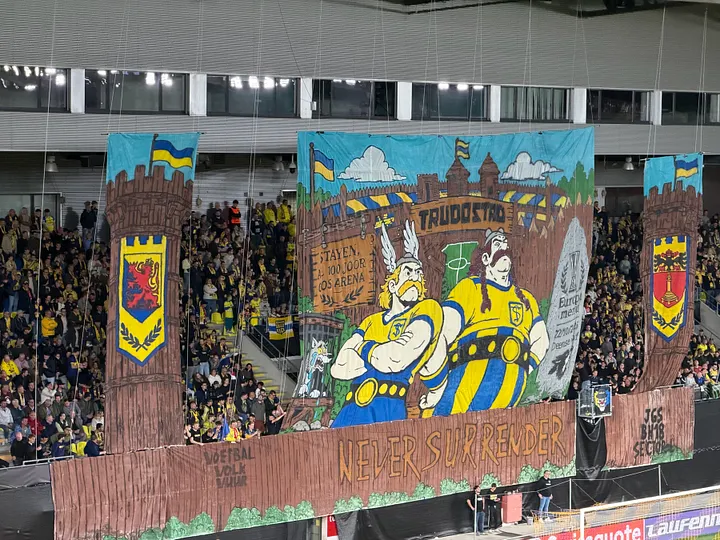
The long-awaited hour also came. The stands of the stadium filled with supporters. The space set aside for the Georgians was also covered with five-cross flags. Fans who had come from Tbilisi joined the Georgians living in Belgium, and throughout the whole match their voice joined the shouts of the locals. Only seconds remained until Mehmet Türkmen’s whistle, and for Iberia 1999 a match was beginning that would test Georgian club football on the European stage once again.
Iberia Will Shine…
“Salome, your flight is at dawn, right?” — a Roman colleague called out to me at the press conference, while waiting for José Mourinho.
I turned my gaze toward them. I was about to say that I had a flight in the morning, when the person next to him asked me in astonishment:
“Why is the club called Iberia?”
“Because Georgia in ancient times was Iberia,” — I answered, but for those sitting two rows behind, my answer was lost in the general noise. He remained astonished again, and I was hurt that I had not managed to make anyone understand anything about Georgia’s Iberian origins.
The disappointment of the night before, that our country’s history was unfamiliar to others, was replaced by anticipation. Now I understand better why it is necessary for Georgian teams to bear names that carry Georgian identity. Iberia 1999’s historic participation on the European stage is precisely the opportunity we need so badly: to be known better on the world’s football and political map. This feeling made me hopeful.
A few minutes remained before the start of the game. The scent of anticipation swirled in the air. The football mood spread to everyone. On one side was Belgian football, on the other the Georgian desire to present themselves worthily in this match, despite the obstacles, and to do honour to the country and their own club.
“You have very few national championship players in the national team,” — a Belgian colleague told me, not hiding his astonishment at the large number of Georgian journalists.
His words seemed to bring me back to reality. They did not know much about Iberia’s footballers. What is more, over the last two weeks they had been trying to find out who the team’s coach was: Andrey Demchenko, Guga Nergadze or Levan Korghalidze. They did not know much about the club’s history either, but they understood where our weak point could be: the quality of the Georgian national championship.
Sint-Truiden’s coach, Frederik De Meyer, built the playing tactics precisely on this weakness.
“I knew that your championship has a low playing rhythm,” — after the match he openly explained to me the key decisions of his game. — “I kept repeating this to my footballers, especially the attacking line: attack, do not drop the speed. I knew that this was our main advantage.”
And so it happened. Iberia lost the match, conceding two goals. In the 11th minute Robert-Jan Vanwesemael brought the hosts the desired first goal. And in the 88th minute Ilias Sebaoui sent the ball toward Giorgi Makaridze’s goal with a powerful shot from distance. The goalkeeper proved helpless: the ball went over his head and confronted Iberia with a fait accompli. The visitors surrendered the match by two goals.
The match statistics also showed Sint-Truiden’s advantage: possession 58% against 42%, shots 20:4, shots on target 5:1, corners 4:0.
Perhaps it was also logical that Iberia shot toward the opponent’s goal only four times, and on target only once. The match showed us that this is the real face of our football, but not the final one.
The Phoenix Effect
“We lost deservedly,” — Levan Korghalidze explained to us after the match, and sharing this reality seemed to give us a sense of relief as well. No illusion, no dream. Iberia’s footballers fought, they gave their maximum, but sometimes the opponent is stronger than you and you have to play as number two.
In the match we also saw two disallowed goals. In the 4th minute Nelson Ishivatari opened the scoring right at the start of the match, but the goal was disallowed for offside. The episode was also checked by VAR and the decision stood. In the opening minutes of the second half the same scenario was repeated. This time Samed Bajdar’s goal was disallowed: during the attack the ball had gone out of the field of play.
From the very first minutes of the match the opponent’s aggressive play, quick combinations and tactical precision stood out.
What did Iberia set against such agile and aggressive play? First of all, defensive organization and an attempt to contain the opponent’s attacks. However, Sint-Truiden’s high tempo and quick combinations constantly forced Iberia to adapt to the course of the game. Possession was on the opponent’s side, and Iberia found it hard to find space and time for attack. Iberia only rarely managed to create dangerous moments near the opponent’s goal. This was not only the score of one match: in this difference the present-day possibilities of Georgian and Belgian club football were also outlined.
The first goal came in the 11th minute of the match. Almost the whole game lay ahead, time both for decisions and for changing the game. However, Iberia failed to create for the opponent a problem that would have forced Sint-Truiden to reconsider its own game.
Andria Bartishvili, toward whom the opponent’s special attention was felt, appeared on the pitch only in the 79th minute. After injury he had only recently resumed training with the team. His late introduction raises a question: could the coach have used earlier the resource that could pose a danger to the opponent’s defence? Or did the footballer’s physical condition not allow it?
However, the problem was not only the absence of one footballer. Iberia found it hard to carry the ball into the opponent’s half and to continue the attack. The coach’s changes could alter individual stretches of the game, but it was much harder to overcome the tempo and intensity that Sint-Truiden maintained throughout the whole match.
The defeat in Sint-Truiden is not a tragedy, but an opportunity to see mistakes correctly. It is necessary to assess one’s own and the opponent’s possibilities. In one day Georgian football cannot reach success: we all analyze this. Learning from the loser, however, is a sensible and healthy reaction.
Does Iberia have a chance of getting through the league phase? The team has come this far, passed the qualifying stage and played in the historic league phase. Now it can fight to the end and, in the remaining five matches, first of all convince itself that, despite everything, it is capable of worthy competition and of fighting for victory.
Iberia will play its next match already in Tbilisi, within its own walls, against Sweden’s Mjällby on 22 October.
And why not: fight to the end…